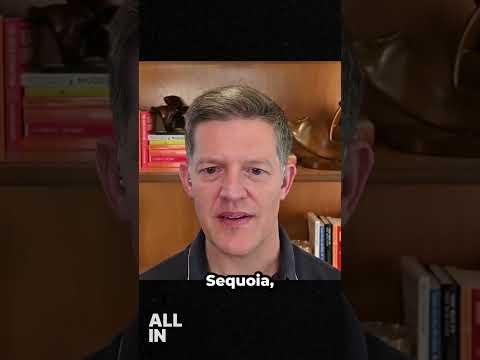
Sequoia’s Roelof Botha: Why Venture Capital is Broken & How Great Companies Are Built
Ask about All-In Podcast
Episode Description
(0:00) Introducing Roelof Botha (1:08) Sequoia’s Scout program and its best-performing funds ever (3:38) State of Venture Capital: Why it’s broken, too much capital, not enough great companies (9:01) Why Sequoia separated from its China business, how they adapt to changing macro landscapes (13:05) Sequoia’s culture, picking partners, investment decision-making, The Sequoia Capital Fund and holding winners (20:18) What makes a great founder, what Roelof learned from Doug Leone and Michael Moritz (26:06) Investing in biotech, importance of expertise in VC
Thanks to our partners for making this happen!
Solana - Solana is the high performance network powering internet capital markets, payments, and crypto applications. Connect with investors, crypto founders, and entrepreneurs at Solana’s global flagship event during Abu Dhabi Finance Week & F1: https://solana.com/breakpoint
OKX - The new way to build your crypto portfolio and use it in daily life. We call it the new money app. https://www.okx.com/
Google Cloud - The next generation of unicorns is building on Google Cloud's industry-leading, fully integrated AI stack: infrastructure, platform, models, agents, and data. https://cloud.google.com/
IREN - IREN AI Cloud, powered by NVIDIA GPUs, provides the scale, performance, and reliability to accelerate your AI journey. https://iren.com/
Oracle - Step into the future of enterprise productivity at Oracle AI Experience Live. https://www.oracle.com/artificial-intelligence/data-ai-events/
Circle - The America-based company behind USDC — a fully-reserved, enterprise-grade stablecoin at the core of the emerging internet financial system. https://www.circle.com/
BVNK - Building stablecoin-powered financial infrastructure that helps businesses send, store, and spend value instantly, anywhere in the world. https://www.bvnk.com/
Polymarket - The world’s largest prediction market. https://www.polymarket.com/
Athletic Brewing - https://www.athleticbrewing.com/
Follow Roelof: https://x.com/roelofbotha
Follow the besties: https://x.com/chamath https://x.com/Jason https://x.com/DavidSacks https://x.com/friedberg
Follow on X: https://x.com/theallinpod
Follow on Instagram: https://www.instagram.com/theallinpod
Follow on TikTok: https://www.tiktok.com/@theallinpod
Follow on LinkedIn: https://www.linkedin.com/company/allinpod
Intro Music Credit: https://rb.gy/tppkzl https://x.com/yung_spielburg
Intro Video Credit: https://x.com/TheZachEffect
Referenced in the show:
Read the full transcriptHide the full transcript
- [Music] Sequoia is the most soughta name in the venture capital business. The firm has made over a thousand
- investments now worth in the trillions in public market value. There's a list of five VCs who I think
- can really transform a company and you're one of those five. When I joined Sequoia, it was clear that
- if I wanted to make it as a partner, you needed to produce meaningful games. YouTube, Instagram, Square. This is a
- list of amazing amazing startups. Our ambition is to build a partnership that endures and that means we need to leave
- it in a better place than we found it. Ladies and gentlemen, please welcome Seoia Capitals Rolloff Botha.
- See you. See you. What's up, bro? How are you? Good to see you. Welcome, Ralph. There's a question.
- What's that? Where did Saxs go? Get to pee pee. He had to make a weiw wee. Come on.
- You Yeah, exactly. You guys did work together for 25 years ago and he just abandons us
- right now. He's had enough of you. Um, everybody wants to know who's your favorite
- Sequoia scout of all time. Let's go through it. Jason Calakanas. It is hilarious. Um, when you think
- about it, you came to me, gosh, 15 years ago, and you said, "I have an idea for a
- program. It's called Sequoia Scouts. We'd like to, um, have you go around and invest in some companies."
- And, uh, no good deed shall go unpunished. Absolutely. Created a monster. Um, but
- that program Sorry, before you ask your question, how far are you going to insert your head up
- Roloff's ass? [Applause] We sat him that far away for a reason. I mean, um, sorry, bro. Jesus Christ. Go
- on with your question. That's Let me land the question. What's your question, D?
- That program, um, had some that first cohort of individuals um, wound up being a pretty interesting
- group of folks. Maybe you could tell everybody just a little bit about that program you conceived of and then who
- were some of the first folks in it and the first investments. We conceived of this program as you mentioned in 2010
- when we launched it and the idea was that there were a bunch of contemporary founders who had very interesting access
- to upand cominging founders who are turning to them for advice but these founders didn't yet have money at the
- point that you became a scout. You didn't have the net worth you have now where you could write a check on your
- own. And so we thought it'd be a great program for us to provide the capital for founders like yourself to be able to
- invest in those companies and hopefully we would get an introduction to those companies for us to be able to make an
- investment too. So uh you were in that program you helped us with the investment in Uber. Sam Alman was in
- that group as well. He helped with an investment in a little company called Stripe.
- They did. Okay. So at this point that that fund is a 26x fund at this point. Wow. That's up there in the
- It's pretty good. What's the best fund in the history of Sequoia? Was it the Google fund, the WhatsApp fund? Which
- one has the highest multiple in history? Uh the highest multiple in history is uh
- I think Venture 12, which has Airbnb, Dropbox, Nera, ADM Mob and a couple of other companies.
- And then venture 13 which is the fund right after that has stripe and square now called block and a bunch of
- other companies. So those were both north of 20x funds. Tell us about the venture industry actually. So we're at a
- point in the cycle where there's been a lot of specialization both maybe at the stage level at the sector level. There's
- been all kinds of experimentation and approaches in strategy. Can you just level set on
- what you've learned and what the industry's learned and where we are? I'm glad you called it an industry, not
- an asset class. Um, I listened to one of the shows you guys had recently and I think there's a huge problem with the
- venture industry that there's too much money and you guys have talked about this before. Uh, venture industry as a
- whole invests right now between 150 to $200 billion a year was the last numbers I saw. If you think about reasonable
- assumptions for returns, let's just say 12% peranom net, which isn't great. Might as well invest in an index fund,
- the math basically implies that you need three and a half to 4x funds to make that math work over a reasonable time
- frame. So if you're investing, let's just say $200 billion a year. The industry needs to give back 7800 billion
- a year. VCs don't own 100% of the company last time I checked. So that means that the aggregate exit value is
- north of a trillion a year. So Figma went public recently. They're worth 25$26 billion. You need 40 Figmas
- a year for the industry to make the returns work, which means that they don't. So in my opinion, investing in
- venture is a returnfree risk. You shouldn't. They're basically only about 20 companies.
- You said return return free risk. risk. Exactly. If you look at every single decade, there are only about 20
- companies that end up getting exit values north of a billion dollars. Actual IPOs or M&As north of a billion.
- Not the paper writeups, only 20 companies. More money doesn't create more great ideas or more great founders.
- So, I think there is way too much money in the industry. The industry does provide a lot of value. It provides some
- of the knowhow for entrepreneurs to succeed and obviously leads to job creation and all the attendant benefits
- for America. But there is too much money and too many people who want to be investors.
- How does the money get level set then and right sized for what is needed? I've been wondering that for 20 years.
- Uh this problem is a problem 20 years ago. It is only it's an incredibly sexy asset class. I
- mean look, Jason writes a bestselling book. It doesn't, you know, dissuade people. It incentivizes more people to
- say, "Oh, I can try this. I'll be like it." I mean, it's just a self-fulfilling prophecy. The more successes there are,
- there's just um Yeah. Everybody wants to go to Vegas and, you know, strike it rich. It
- doesn't happen. Yeah. That's part of the dynamic is that you get a firm that has one success in their
- fund and then they attract more capital because people think it's repeatable and
- it's not. And you don't know you don't know that till fund three or four. Like often they
- raise fund three before they've even oh they've raised fund two, three, four, and five before even fund one is really
- fully distributed a lot of times. So what could change for one one of the things that I thought was transparency
- but nobody wants to publish their returns. You could publish your returns. I publish my returns but you know I'm
- not taking outside capital but would that help? Like is it working with people like Cambridge so that these
- things become more public and more understood? It seems like there's an education element here that's missing on
- behalf of the industry to the potential LPS. I think people will still hide behind the J curve effect and they'll
- say yeah my fund is only at 1.5x right now but it's only four years in and you know the winners are going to emerge and
- so I think this this hope springs eternal dynamic and such a long time period of gestation before the companies
- get realized that I don't think that uh will change that dynamic unfortunately there's also been this really
- interesting effect where it's been this industrialization of venture capital I will call it so if you look at the
- organization that has built the organization that General Catalyst has built. It's about this girthiness,
- right, across many different things. How has Sequoia reacted when they've seen those movements? And I'm sure
- you've had to sit down as a partnership and say, are we matching this? Are we copying this? Are we going to do the
- same thing? Are we doing something different? That is a great question. The industry
- has changed a lot since I got into venture just over 20 years ago. If you go back to the proverbial 1990s venture
- firm, it was, you know, a dozen people sitting around a table making investment decisions with very lightweight staff.
- Uh, and it was much more of a cottage industry. I think the industry is professionalized and really the founders
- are the ones who benefited from it because all these firms have built larger operating teams to be able to
- help those founders with talent, with go to market and so I think it's really helping founders. That's probably the
- main takeaway I have from that. We've decided to not build as big an organization. Most of the operating
- teams we have at Sequoia help us. So we have about as many developers at Sequoia
- as we have investors and they're building products for us so that we are much more effective and productive than
- we might have been 20 years ago. What's an example of that that they're building for you?
- Uh so you know my phone I can pull up an app that I if you give me any company name I'll be able to tell you who my
- team last met, how we rated it. I'll give you uh data on what's happening with their hiring. Uh how many vouched
- employees they have, how good do we think their engineering team is based on their history, their academic profiles,
- etc. All this information is at my fingertips. Uh if we get business plan submissions, we have an AI system that
- will summarize it for me. So I get a very quick read on the company, a quick summarization of the quality of the team
- and a very quick analysis of the competitive dynamics and the other companies I should consider alongside
- them. So these are just small examples of the things we do. We just had Joe Saiion on. We're talking a bit about the
- relationship between America and China. You had a fabulous business in China for
- two decades, I believe, with Neil. Yeah. And it did absolutely fantastic. But then the government of the United States
- said, "Hey, we cannot as venture capitalists invest in China anymore." So, what are your what's your take on
- the the opportunity in China? Will that return? and and just the the experience you had with all those incredible hits
- at the time. When we first went into China, it was 2007 I think. Uh the world was flat was
- the moniker at the time. China gained admission to the World Trade Organization in I think 2001
- and we all believed that it would integrate into the global economy. That premise proved wrong. And so we had a
- period where it was really interesting to be able to share knowledge and share ideas and sort of figure out how we can
- build a globally interconnected set of systems and companies. Uh and life just got too hard for that honestly and we
- saw just more division between the two countries. So we embarked on global separation just over 2 years ago and
- what used to be China is now an independent business called Hongchan and they're off to the races. I think
- there's a real challenge in China right now. Uh some stat I got recently in 2018
- there were 51,000 companies started in China. In 20123 it was 1,200. Wow. How many?
- 1,200. You had a 98% reduction in the number of companies founded in China. Cuz if you're an
- entrepreneur in China, why would you want to start a company when the government regulations are so uncertain?
- Which by the way is an interesting warning sign for me for us in America as we think about AI policy and AI
- regulation. The more uncertainty we create for founders, the more difficult it is for them to actually take that
- risk, take that leap to start a business. So, but Chinese entrepreneurship is still strong. So,
- you see many Chinese entrepreneurs now operating in Latin America, they move to Singapore, they're in uh Japan, they're
- moving to Europe. I mean, you can't repress that spirit. Rolof, there's a interesting dynamic that I observed
- which is you have the early early stage venture companies who have had an incredible track record. you guys,
- Benchmark, Kosla, and then what happens is you have these latest stage firms, but many of the
- companies that they fund need so much money that the latestage firms can't service them. So, you have to go direct.
- You go right to Saudi, you go right to the Qataris, you go right to the Amiradis, you go right to Norway, you
- know, these sovereign wealth funds that are writing these big checks. And so, it
- creates this really weird dynamic where you almost become this kind of glorified
- placement agent almost. So there's this part of the curve and then there's all this money that goes over here. How do
- you adapt the business in the face of that dynamic? Well, we stick to our knitting. Uh the
- funds we operate today, our seed venture and growth funds today are no bigger than they were 5, six, seven years ago.
- We we realize that there's money to be made for some people writing very large checks and very latest stage companies.
- But uh our aspiration is to be the number one investment manager for our limited partners. We literally want to
- be the best net IRRa and net multiple for our LPS and we're not interested in maximizing fees or maximizing share of
- industry value creation. That's the game we've chosen to play. And so there's no path where Sequoa for
- example tries to go public or take the you know that's like it's just not in the strategy of the business. No,
- actually we've structured ourselves to be a private partnership in perpetuity to the extent possible under California
- law. We have the sense of stewardship. You have to leave the partnership in a better place than you found it. Don
- Valentine didn't call it Valentine Ventures when he started it. He handed the partnership over to a next
- generation with Mike Meritz and Doug Leone and Jim Gett. And you know, we're now part of a third generation, our team
- currently running the partnership. We didn't have to pay to get the partnership from the previous generation
- and nor will we charge the next generation. That's that's our motto. How would you describe the culture
- that's driven the success rolloff? So when you select partners, what do you look for? How do you value those
- partners? How do you assess the performance of those partners? And how do you guys operate that kind of defines
- the culture? So I think the probably the most important characteristic we look for is
- an insatiable curiosity in the individual. We look for people who are extremely driven, but they need to have
- a heart of gold. So one of the things we talk about at Squay is um we cherish individualism and teamwork. You need an
- individual to be able to have a keen insight and propose an investment but you've got to work with a team and that
- the whole teamwork aspect is really important for us. So when you make investment decisions at Sequoa it's a
- consensus decision which blew my mind when I first got there. I meaning everybody has to agree.
- Everybody has to agree. So if one person says no it doesn't happen. Correct. So one person can veto an investment.
- Correct. And that happens often or it has. Sometimes it was a good decision and sometimes not.
- What do the statistics tell you? What's the worst uh thing somebody killed? Oh jeez.
- It's okay. We're all friends here. What is that list called when you have that? Yeah, you would call it your anti
- portfolio. Anti portfolio. But in this case, somebody wasn't just an anti portfolio. It's like
- everyone agreed we should do it except the one. Yeah. Yeah. And so you think about that
- responsibility uh and it weighs on people, but it means that you need to show up
- with your best game every single day. And you know, part of what we've done is we look at the vote distribution these
- days and look, if somebody shows up and everybody's really positive, there a bunch of people that are eight nines out
- of 10 and there's one person who clearly woke up at the, you know, in a bad mood
- and is a three, you know, at some point that person will probably say, "Listen, maybe I just don't get it."
- This actually happened to me. We listened to a company in late November. This company is thriving right now.
- They're in the it's pretty sax isn't here because this company's benefiting from stable coins with the genius act
- that he helped put in place is really benefiting from that and I didn't quite get this company at the time and I was
- the only person who was below the line and I said listen there's something I'm missing in this particular company. I
- think we should proceed with the investment even though my intuition walking in was that we shouldn't
- and I'm really glad that we proceeded. So can you tell us about the holding company transition that you underwent
- and the role of being a venture capitalist in making an exit decision? So we did this conversation on the show
- a few weeks ago. Pulled up some analysis. The biggest winners continue to compound as public companies. 99% of
- the returns are as a public company or whatever it is. So it looks like an amazing exit goes public.
- But that's not the end of the value creation. True compounders compound for decades. Especially founders are still
- in the seat. Amazon, Nvidia was a Sequoia investment. I think Google, I mean, these are multi-trillion dollar
- companies that if you guys held your position to today, I'm assuming things would look a little bit different.
- It would. Yes. So, so we backed a bunch of very interesting companies over our 50 years. Uh, the companies in which we
- were private investors when they were little companies today account for over 30% of the total
- value of the NASDAQ. Wow. There's no other 30% over 30% of the combined value of the
- NASDAQ. Apple, Nvidia, Apple, Cisco, Nvidia, Google, Pala Network, Service Now, uh I mean the list
- goes on. So pretty pretty good. So So one of the things we realized, what you're alluding to is in 2022, we
- launched something called the Sequoa Capital Fund. And so we realized that the great companies continue to compound
- as you talked about in that episode. It was it was an excellent episode obviously. Um, and by the way, even in
- more recent memory, if you look at the last 10-ish years, Palto, Service Now, HubSpot, MongoDB, these companies have
- all been 10 X's as public companies. And so, we've realized that when we distribute shares prematurely to LPs,
- they don't know any better because, you know, they run a big endowment. They suddenly get $5 million worth of company
- ABC. They don't know any better. They sell the shares. So, what we've decided to do is for the companies that we
- believe have the ability to compound longer term, we have a different fund structure. And so 6 12 18 months after
- the IPO, we can move those shares into this fund called the Sequoa Capital Fund. And this now becomes the vehicle
- through which we fund all our next underlying investment vehicles. Now to give you a sense, since we launched this
- 3 and a half years ago, we've accumulated another 6.7 billion in gains by doing nothing except being patient.
- $6.7 billion in gains that our LPs would not have seen if we had just distributed
- those shares outright. Yeah, you're making him moan. He's moaning. I like it. I'm getting I'm getting
- getting warm and he's getting emotional. But what is but what is the So the counterargument is as a public company,
- you as venture capitalists who are excellent at interrogating early stage technology, early stage metrics, founder
- personalities, all the things that might make a good venture capital investor. Maybe as a public company, quarter to
- quarter, are they growing 12%, 14%. There's a different analytical skill set some might argue like you know that that
- belongs in that investment domain and frankly very hard to beat the indust indices doing that. What's the argument
- to be made to the counter and why would you counter that argument? So see one of the things for us is that
- the I mean most of these cases we're involved with these companies literally at inception. I mean Palo Alto Networks
- was incubated inside our office with one founder and my partner Jim Gates. So, we've known these companies since the
- earliest of days. Why should that relationship end at the IPO? And in most of these cases, as you
- pointed out, the founders are still there and there's so much more innovation taking place. Um, Jack
- Dorsey's one of Jack Dorsey's favorite quotes to me was companies have multiple founding moments. And so when you're in
- a company where the the founder keeps reinventing the business, you know, a company like Square, half the revenue
- today comes from a product called Cash App that hadn't launched for the first 5 years in the company's life. And so if
- you can find these companies, these special companies where the founders keep pushing the boundary on innovation
- and they are relentless, then it works. Google buying YouTube. Don't remind me. Do you think it would have been the
- same? Would YouTube still have had the same outcome if it wasn't acquired? To be clear, RUF wrote in his first year or
- two at the company, the deal memo to invest in YouTube and it got bought for 1.6 billion. Standalone business today
- would be worth 400500 billion. And then Google then invested quite significantly in infrastructure and
- enabling scalability and building out a team and building out an ad revenue system, etc. We've got Neil here
- tomorrow to talk about the current state of YouTube, but do you think it could have taken the same? It's hard to say.
- Hard to say. Uh I think a lot of credit should go to Google for the way that they managed YouTube after the
- acquisition, both in the resources they provided, the leadership um and they've enabled it to thrive. This is one of my
- favorite things that Peter Thiel says is uh you know when you make it when an acquisition like this happens one side
- was orders of magnitude off like it was just a zero or it was 100 more than what
- they paid. Something is always off. Anyway, Don Valentine um the founder of the firm
- drew a four quadrant chart at one point to explain the founders that uh perform extremely well in terms
- of returns. Maybe you could explain that to the audience. Yes. Uh Don pulled me aside in the early
- days when I joined Sequoia and he said 2x2 matrix uh people are exceptional not exceptional easy to get along with not
- so easy to get along with. Ruof we normally make money in one of those four quadrants. Your job is to figure out
- which one and it's the exceptional people who are not so easy to get along with.
- Uh so then let's talk about the next generation. I'm sorry. Can we just double click on
- that? Why do you think that is? These people change the world. They don't take no for an an for an answer,
- right? They are How does it Why does that make them hard to get along with, per se?
- Well, I think he was he was saying that a little bit tongue and cheek, right? But this is a guy who backed Steve Jobs
- when Steve would walk around Sand Hill Road without shoes. He'd come back from a trip to India. Allegedly, he didn't
- smell too great. Um, and he was unusual and nobody wanted to back him. And you know, Don wanted to find these
- underdogs, these unknown Atari. Well, apparently some of the Atari board meetings took place in hot tubs.
- Yes. Uh he told, by the way, that's how he got to Steve because Steve had worked at Atari.
- That's how Don got the introduction to Steve. So, so I think part of the point he was trying to make is don't look for
- the people that, you know, went to all the right schools and wear the right clothes, all the conventional stuff.
- Founders are unconventional. These people change the world. I mean, most of us encounter challenges every single day
- and we accommodate. you know, this thing isn't quite to your liking, you adapt. Founders don't. Founders see things and
- go, hm, I think the world can look different and then they go and try to fix it. They just don't take no for an
- answer. So, let's fast forward to your two mentors, Michael Moritz and Doug Leone.
- Two very different characters when the story gets told, maybe a rivalry there um between the two of them. What did you
- learn from each? Sure. From Doug, I learned heart. Unpack it. Doug has an incredible heart.
- When did you see that most? What was the moment that's coming to your mind right
- now that you probably shouldn't talk about? Well, the I'll give you two examples.
- One was in 2009 when I was in a funk. I nearly quit the business. Um I didn't know this really.
- Well, we'd had the YouTube was a great success. Uh and I felt very good about that. And then you in venture after a
- few years you val you walk through the valley of despair and you start to realize the things you should have
- invested in that you didn't and the lemons start to drop the things that you did invest in that are not working out.
- So yes there was the one great quick exit but then a bunch of other things and I was really having a lot of
- self-doubt and Doug showed up at my house with a homemade pesto jar and he didn't need to. It was on a
- Saturday afternoon. He knocks on my door. Who's this person at my house? and he just wanted to tell me that he was
- there to support me through this dark period. That was one example. Another one was when uh my son was in hospital
- and Doug showed up. Didn't have to. Um that meant a lot to me. So, and Michael, Michael's imagination.
- Michael just has an unbelievable ability to imagine how a company can succeed. And when I thought about my mistakes as
- an investor, by the way, every single time it comes down to a failure of imagination, that I didn't think big
- enough. I didn't think about how this company could uh progress from where they were. You first introduced me to
- Twitter 2007. I have the emails before smartphones launched and it was an SMS app. I got tired of getting all
- your I'm having cappuccino messages on Twitter at the time. I remember on your Blackberry. Yeah.
- And I didn't quite imagine that it could be what it is today. And so that to me was an example. Uh, I remember an early
- meeting with Yelp with Jeremy Stppleman and Max Lechin in our offices and I mean
- Yelp hadn't launched a web app that were going to be an email newsletter thing and Michael in this meeting said I
- imagine that one day restaurants will put a Yelp sticker in the window just like a Zagat or a Michelin star. And he
- saw that. He saw that. He saw that. I mean 10 years before that became a reality he had the imagination
- to think about that. That to me is amazing. So now Doug is still there and Mike has transitioned out. Is that the
- what is Yes, Michael has transitioned out completely. Doug has stepped back from
- day-to-day investing. So he's no longer in partner meetings routinely, but he continues to serve on several boards.
- And you're in charge. I'm the leader of a team and I think of more like being captain of the team. You
- play team sport. We play team sport at Sequoia and you know we are equal partners and you know it's
- Was it hard to see those two guys go just seeing how legendary they were? to succeed them? No.
- Well, both to succeed them, but also just to see them walk out the door. Like, is there a tendency to want to
- keep them around as long as possible? I understand the question. Um, well, well,
- firstly, it is very hard to succeed them. I think every single person in Sequoia feels this enormous burden and
- responsibility to try to match the performance that we've been known for, you know, but we have this great
- generational transition at Sequoa. So, Michael stepped back from day-to-day activity in 2012
- and he was Morris did in 2012. of Michael stepped back. He had personal health reasons and
- he stepped back. He continued to serve on the boards that he was on and we we had him for another decade where I would
- ask him for advice. You know, as we were going through global separation that we
- talked about earlier, I would ask Doug and Michael, you know, what do you think should we you know, what should we be
- doing here? Do you have advice for me? And so it's a we have this benefit of intergenerational uh knowledge transfer.
- Uh Doug was on a call earlier today. Actually, we had a difficult conversation. I wanted his input on an
- important question and it's not because he has the authority to tell me what to do. It's because I seek out his advice.
- You were investing in traditional software, internet services for years and then a couple of years ago you
- started investing in some life sciences. Does life sciences kind of work as a venture investment today? And what's
- been the challenge in biotech and life sciences investing generally over the last few years? There's a lot of
- notoriety about the collapse of the market and even Dave Ricks today was saying most public biotech companies are
- trading below cash. What's your observations on the business model, what you've seen, the types of businesses
- you've invested in there? So, so the business we invested in uh that has done really well is a company called
- Nater. Uh and we made a seed investment of a million dollars in 2007 in this company.
- It's 20 billion now, right? Market cap. $22 billion market cap. It was a million
- dollars. two people uh with a a very raw idea and today they're the leading provider of prenatal testing, oncology,
- recurrence monitoring, organ transplant projection testing. And so that company's been a huge success.
- Diagnostics, genetic diagnostics, has been a huge success. And you think about the the dividend we're still collecting
- from the human genome project 25 years ago. It's incredible. And you've obviously seen that in some of the
- businesses that you've helped build as well. uh we did make an investment in a company called Bridge Bio which is
- helping with rare genetic disease drug development. Uh but other than that I think we're we just don't have the
- expertise for biotech. You know we don't have any M but there are still winners.
- There are still winners but we have no MD PhDs on our team at Sequoia. And I think you know it's very dangerous when
- people think that your success in one domain just naturally makes you uh gives you the right to compete in other
- domains. I think I have tremendous respect for the people who understand that. I do not.
- I learned that one the hard way. Ladies and gentlemen, Roloff. Thank you. Thank you.
- Thank you so much. Thank you, sir. I appreciate you coming out. Thanks.
Brief Summary
Roloff Botha discusses Sequoia Capital's investment strategies, industry challenges, and the importance of teamwork in venture capital.
Key points
- Sequoia's Impact on Startups. Sequoia has made over a thousand investments now worth in the trillions.
- The Sequoia Scouts Program. A program conceived to empower founders to invest in emerging companies.
- The Venture Capital Landscape. The venture industry faces challenges with too much money and not enough great ideas.
- The Importance of Patience. Sequoia's new fund structure allows for long-term compounding of investments.
- The Importance of Founders. Founders often reinvent their companies, leading to unexpected successes like Cash App.
- Doug's Heartfelt Support. In a moment of personal struggle, Doug showed up with a homemade pesto jar to offer support.
Episode highlights
- The Sequoia Scouts ProgramA program conceived to empower founders to invest in emerging companies.“It's called Sequoia Scouts. We'd like to have you go around and invest in some companies.”1:27Oct 9, 2025
- The Venture Capital LandscapeThe venture industry faces challenges with too much money and not enough great ideas.“I think there is way too much money in the industry.”5:27Oct 9, 2025
- The Importance of PatienceSequoia's new fund structure allows for long-term compounding of investments.“We've accumulated another 6.7 billion in gains by doing nothing except being patient.”17:26Oct 9, 2025
- The Importance of FoundersFounders often reinvent their companies, leading to unexpected successes like Cash App.“Founders keep pushing the boundary on innovation.”19:08Oct 9, 2025
- Doug's Heartfelt SupportIn a moment of personal struggle, Doug showed up with a homemade pesto jar to offer support.“He just wanted to tell me that he was there to support me.”23:13Oct 9, 2025
- The Power of ImaginationMichael Moritz's visionary thinking helped foresee the success of companies like Yelp.“He had the imagination to think about that.”24:30Oct 9, 2025
- Generational Transition at SequoiaReflections on the transition of leadership and the burden of legacy.“Every single person in Sequoia feels this enormous burden.”25:20Oct 9, 2025
- Navigating Life Sciences InvestmentsDiscussion on the challenges and successes in biotech investments, highlighting Natera's growth.“It's $22 billion market cap now, right?”26:48Oct 9, 2025