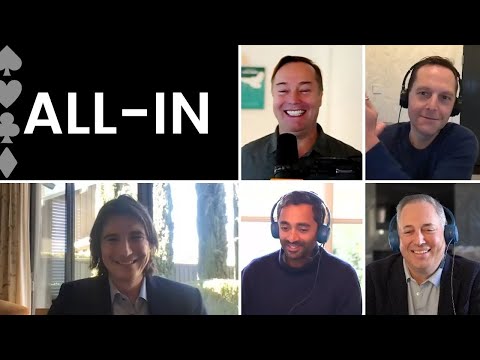
Why Secondary Markets Are Eating the IPO | All-In Liquidity Secondary Markets Panel
Ask about All-In Podcast
Episode Description
(0:00) Brad Gerstner, Gavin Baker, and Kelly Rodriques join the Besties! (0:47) Secondary Markets are Booming & Competing with IPOs (3:10) Why Companies are Staying Private So Long? (9:22) SPVs, the Forge-Schwab Deal, Democratizing Private Market Access (13:28) Secondary Markets as Exit Liquidity for VCs (27:00) The Private Market Bubble? (32:03) Hottest Secondary Companies Right Now
Thanks to our partners for making this possible!
EY - Agentic AI is introducing a new investment discipline. As AI shifts to consumption-based models, EY connects spend to enterprise value. https://www.ey.com/en_us/insights/ai/agentic-ai-token-costs?WT.mc_id=3501318&AA.tsrc=sponsorship
NYSE - Thank you to our partner, the New York Stock Exchange - a modern marketplace and exchange for building the future. It all happens at the NYSE. https://www.nyse.com
Plaud - Never miss a moment. Plaud, our official wearable AI note-taking partner at All-In Liquidity Summit, captured every insight. https://www.plaud.ai
Follow Brad: https://x.com/altcap
Follow Gavin: https://x.com/GavinSBaker
Follow Kelly: https://www.linkedin.com/in/kelly-rodriques-9b49418
Follow the besties: https://x.com/chamath https://x.com/Jason https://x.com/DavidSacks https://x.com/friedberg
Follow on X: https://x.com/theallinpod
Follow on Instagram: https://www.instagram.com/theallinpod
Follow on TikTok: https://www.tiktok.com/@theallinpod
Follow on LinkedIn: https://www.linkedin.com/company/allinpod
Intro Music Credit: https://rb.gy/tppkzl https://x.com/yung_spielburg
Read the full transcriptHide the full transcript
- Everybody wants access to these private markets. Joining [music] >> us right now to discuss all of this is
- Kelly Rodriguez. He's a Forge CEO. We see a world where the [music] private market opens up and is accessible to any
- US and global investor. There's 19 companies in the private market AI basket. These companies have grown on
- average 300%. >> Please join us in welcoming Gavin Baker, managing partner and CIO of Atrades. The
- ROI on AI has empirically, factually, unambiguously been positive. Investing is the search
- for truth. We welcome in Brad Gersonner. It's good to be back with you. You have
- a program called Invest America. >> I think we have a historic moment right now to get [music] everybody into the
- game of capitalism. >> Do we have a few slides from Brad to kick this off? >> You know, let's startic like old times.
- like old times. This uh this panel I I actually was backstage. I said, "Gavin, do you know we're talking about
- secondaries?" He's like, "What do you mean?" And I said, "Okay, so here, let's just set this up for everybody. The
- room's full of people who are allocators. People are looking for distributions. So this is um secondary
- markets over the course of the last decade. This is the amount of money going into VC each year, the amount of
- money coming out of VC each year. The red line represents the net effect of that. So Jamath, we're in like 5 years,
- right, where a lot more is going in than's coming out. But the secondary market is at record volume. So this is,
- you know, I call these companies quasi public companies. These are these later stage companies. There's buying and
- selling that's going on every day. Look at that, Jason. Relative to the 21 peak.
- We thought that was crazy at the end of 21. We're double that now in terms of secondary transactions. This is the
- amount of employee secondary. So this is people buying into Anderal, Anthropic, SpaceX now represents 31% of all primary
- venture activity is buying into these secondaries in 2025. Secondaries are now competing with IPOs
- and acquisitions as the principal way that these guys are exiting. So, I thought that was a decent setup to start
- the conversation this morning just to level set how important secondaries [clears throat] have become. And then
- the final one is secondaries over the last couple years were trading at a discount to market. So, if we wanted to
- sell shares in one of our companies, right, to buyers out there, they were willing to give us 80 cents on the
- dollar in order for us to get liquid so that we could send DPI back to our LPS. Today it's at 106. Uh uh so a premium in
- the market as a coupon. >> And this doesn't include some of the wild west of SPVS that have been
- unraveled recently. >> People charging 10% loadin fees, double carry and a lot of gray market offmarket
- stuff. This is also having a profound impact, Gavin, on employees at these companies that I want to hear about
- because you've seen it up close and personal with SpaceX and they have a very orderly process here. So, why don't
- we start there? What impact is this having on the employees, Gavin? And then on the market, how orderly is this? And
- and who are the buyers? Are the buyers the sucker at the table? are these family offices, high netw worth
- individuals who keep hearing us talk about Anthropic or SpaceX or Andril and they just say I have to own the name and
- they're not discerning. So Gavin, maybe you can start about the impact on the SpaceX employees you saw firsthand, etc.
- Well, maybe broadening it beyond SpaceX, I do just think if companies are going to be staying private longer, this is
- absolutely necessary. There I think there are a lot of people who are very um very wealthy on paper but actually
- cash poor and if you're making tremendous sacrifices uh because you know you work for a
- company that you really believe in and you're contributing a lot to that company. It's hard if you can't buy a
- nice house for your family. It's hard if you can't afford to do nice things, >> especially in year seven, eight or nine
- of working at the company and you tell your spouse we're worth 10 million on paper, 30 million on paper and you don't
- own your home. >> Yeah. Or year 15. And so I think this is necessary and important and you know
- whether it is good or bad, I think it is very clear that companies um are going to stay private for longer.
- >> What's the reason to stay private longer? Truly >> I I I don't think there is actually a
- good reason to stay private longer >> here. Here >> and >> I completely agree with you too.
- >> Yeah. And I >> Why has it happened? This is founders don't want let's just call it what it
- is. Founders don't want to be under a microscope. They want to build and enjoy life and have it easier than being on
- the public market microscoped. >> Yeah. I think there is a perception that life as a private company is easier and
- you have more freedom and you can think long term. I don't agree with this. I always think
- about um Mark Zuckerberg's commentary that had he been public. So just you know Facebook um I won't call it a
- near-death experience but long ago it's difficult to believe but I don't 10 112 um Facebook did not believe in apps they
- believed in something called HTML 6 >> and HTML 5 >> HTML 5 HTML 5 Yes. You you you you were
- the actual >> it was the cataclysmic debate and it was me and Brett Taylor. Me versus Brett. I
- was like apps I want to go build a phone. Brett was like HTML 5. Zuck picked Brett. Spent the next three years
- unwinding that decision. >> Absolutely. And Mark Zuckerberg and basically the idea was you know the
- iPhone comes out and initially there was not a big app app ecosystem and there was a thought that hey there's no need
- for apps. you're just going to use the web browser on your phone and HTML 5 was a way of look of making websites look
- mobile native >> dynamic. >> Yeah. And this seemed like kind of the future to a lot of very smart people
- including Google, Facebook. Um but it was not the future. Um it was wrong. And what Mark Darker has said, I think
- several times in public is he profoundly believes that had he been a public company
- um when you know there was this internal debate between the and the detail was actually I went to Zuck and I said I
- need a billion dollars to build this phone and we are in this moment in 2010 where we can have the third leg of the
- stool. there's Android, there's iPhone, neither have really taken off yet. And and he's like, we don't have a
- billion. And I said, but the public markets will give us a billion. And he said, no, but then we went public a year
- later, >> but that year made all the difference. >> Made all the difference. And he said
- that had I had the constant pressure testing from public market investors, you there's a dynamic. I was I was
- talking to another CEO here this morning. When you're the CEO of a private company, you are the most
- special flower to all of your investors. [laughter] You're like, you are as important to your board members,
- particularly if you're really successful. You know, maybe as the board members families or parents, you know,
- the board members think about you a lot. Um, once you're public, you're one of thousands of companies. Um, and that's
- its own dynamic. But the consequence of this is is that private investors are often selling to management teams. And
- at some level that can mean telling management teams what they need to hear because you want to be able to keep
- participating in the rounds. Once a company's public, you can buy or sell as you wish. And this means that investors
- feel freer to give companies management teams. And Zuckerberg Zuckerberg said, "Had I been public, had I been getting
- rigorous, detailed questions from really smart public equity investors, I think I
- would have, you know, by the way, the second unwritten story of that, which has never been said, he called me. He's
- like, "Hey, man, what the is going on over there?" Uh, and I was like, "Yeah, I know." Cuz I had just left and then we
- wrote a deck and I walked over to Zuck and I'm like, "Here's the deck of what you need to
- do." Yeah, >> do these things. Well, this is a key point. I think Gavin is when you're
- private, you do not get clean information as the CEO and the management team because people want
- access and once you give the truth or you ask the hard questions, you might lose access
- >> 100%. >> The sickopantic nature of private markets is real. >> Now, an exceptional CEO
- >> Elon >> seeks out negative feedback. looking for that. >> But not many and actively discards, but
- not many CEOs maybe are are wired that way. And by the way, I do think we have to give Brad credit. That was a very
- good deck. You said back in 2012. >> No, cuz he did a second one. He had >> when he did the second one, he did the
- open letter to Zuckerberg at the end of Was that at the end of 22? >> October 22.
- >> Why don't you call it? Get fit. What was the uh time to get fit? >> Time to get fit. That was an impact.
- Those are two very impactful. >> Okay. So look, there's you're you're hearing the bulls on going public, but
- Kelly, take the red team the other side because you're on the other side. You built a private business, you sold it to
- Schwab, so clearly one of the largest financial institutions now is going to ram its way into this market. But then
- you're seeing a lot of push back. Anthropic is like, "Hey, uh, dissolve these SPVS." OpenAI, I think, was saying
- today now, dissolve these SPVS. Should we dissolve the SPVS? Where are they coming from? And why are you on the
- right side of history? >> And and have you had to dissolve any of the ones on your marketplace?
- >> No. >> No. Look, I think that uh first of all, being a private company CEO for most of
- my career and then being a public company CEO for three years, I recognize the job is incredibly different. It's
- much less fun. Uh you're not doing >> Hold on. What do you mean when you say much less fun? Turning into an
- investment manager primarily as a public company CEO is a very different job than being a
- visionary [clears throat] product first uh first principles business when you become a public
- company CEO everything changes and I would say in the world we're in now the kind of capital you can raise the kind
- of capital that was represented in the very last discussion allows you to extend extend your private life. SpaceX
- private company for 24 years. Um but the reality is these SPVS that are now emerging because these companies are
- getting so big is because a market's trying to happen and a company like SpaceX has done this
- extraordinarily well. They've run essentially liquidity programs for almost a decade
- because there's so much pent-up interest in both being an investor and getting liquidity for some of the reasons that
- Gavin was mentioning. So I think what we see now is the next phase of this this Schwab deal with Forge basically says to
- the world this is a real asset class. It's more than just secondaries. We're going to put these companies, the
- company's equity into fund products into very well-managed, regulated SPV structures because they do serve a
- purpose in the market. >> Yeah. But if you're how do you convince Elon specifically to give you access to
- that when he wants to do it himself and he has a team and every six months he runs it himself? How do you get access
- to that? What's your pitch to the next Elon? >> Here's the pitch. The pitch is you're
- going to go from being a private company eventually to a public company. What Schwab represents is 46 million
- investors and 12 trillion. This will change capital access and the way that you distribute your shares
- moving from private to public. >> How did that work when you pitched them on that?
- >> Were you Well, I'll tell you. We got our first SPVS on SpaceX in 2018 and 2019.
- Were they was he okay with it? >> Absolutely. Totally permissioned. And then as we got closer to the IPO, we
- said, "Guess what? Um, we've got 30 million retail investors that would like to have a $50,000 slice of SpaceX."
- And and he went out [snorts] publicly and talked about having broad-based distribution
- >> at the IPO price. >> At the IPO price and Schwab was named one of the IPO allocations.
- >> Beautiful. I do think this is actually a very effective pitch. I think a lot of
- these CEOs, they're a little bit ambivalent about, you know, and I think they understand that maybe the
- institutions who are investing in these private rounds, you know, they may represent, you know, unions, they may
- represent retirement plans, but I do think they like the idea of democratizing access and if they're
- building something that they think is great, giving ordinary Americans an opportunity to participate. I actually
- think that's a very appealing story to to a lot of these CEOs >> because they're capitalists and and they
- understand the power of equity. So Brad, >> what is the downside then of cuz you're
- part of the go direct movement now? BG2 pod officially fifth bestie. Gavin officially sixth bestie. You [laughter]
- got that's Gavin. That's new news. We officially made you six bestie today. >> But does that mean I'm definitively
- behind Brad? Cuz [laughter] that that's the real news. >> I can You're standing behind Brad.
- You're just giving him that big bear hug right behind him. >> Wow. >> So, are you saying I'm the big spoon?
- >> You're the big spoon now [laughter] in the in the side draw with the extra spoons.
- >> But Brad, it's getting very weird very quick. >> In all seriousness, with great power
- comes great responsibility. Sometimes the, you know, the enthusiasm people can have can exceed reality.
- >> Correct. >> Going direct, you've become more measured. I've noticed as your profile
- has gone up. >> I think all of us have to like just make sure people don't blindly follow trades.
- Don't >> you were talking stuff down on CNBC a couple of times saying, "Hey, I don't
- think the average American needs to be in some of these companies. There's time."
- >> I get worried. I get worried at this point in the market stage, particularly on CNBC where you're talking to retail
- investors at home. Yes, >> I was one of those retail guys looking up to everybody on this stage, trusting
- everybody on this stage. And when people are telling you to yolo into right double fee structure, SPVS and all this,
- you know, like it's time to be careful, to do your work, to be thoughtful. We're
- in this because we want this to be durable democratization for a long time. Yeah.
- >> We want to build trust among those who feel left out and left behind in capitalism. We all think that we need to
- go public sooner. The reason I think we it is destabilizing when you're creating trillions of
- dollars in private value and 80% of America think it's a scam where they're left out and left behind. That's
- >> and then they come rushing in >> and they could be not so good cards, >> right? So, all I'm saying, like I said
- about they asked the question on CNBC last week, if you had $100,000 of fresh capital and you were sitting at home, is
- today the day that you would shove it all into the market? And I said, no, I think about it in sizes, right? We just
- had two of the biggest months in the last 10 years in the public markets. They've been big months. So, if I had a
- stack of a hundred, I may put 30 to work today. I'm never going to pick the bottom. I'm never going to pick the top,
- but I certainly wouldn't be putting it all to work. And I'd say the same thing about latestage privates, people who are
- yoloing into this stuff, and then they feel really disappointed. They're like, "Hold on a second. I bought the SpaceX
- IPO and it didn't go up 3x." >> Let me ask you then. >> Yeah. >> Do you view this as exit liquidity for
- you? Like, would you shape your portfolio and returns and increasingly say, "You know what? I don't know when
- this guy's going to go public." >> Yes. >> Let me just pump the stuff out. Let me
- get the distribution. and let me send it to my LPs and just call it a day. >> We we are selling into this.
- >> You're selling into this, >> right? So, I have LPs in this room who say, "Listen, we invested in your VC5 or
- VC6 7 or 8 years ago. If you can go sell a slice of that at four or 5x and we get
- DPI and it's priced really high, then go sell some of it." And we often don't talk about this in Venturland. Half of
- what we do is in the public markets. Gavin and I get up every morning and we think to ourselves, should we buy today
- or should we sell today? Venture capitalists don't think about the sell part. They think about the buy part. So
- one of if we're going to stay private for longer and we're going to have trillion dollar you know private
- companies and data bricks at $200 billion you got to think about is today a day we should be selling some and
- returning it to our investors because >> doesn't it create though as as what Jason said these very complicated
- personality dynamics where maybe you get shut out of a new company maybe you get
- shut out of an incremental round and you know there's bad blood because you're a
- credible investor And there's this signaling risk. Whereas in the privates, if you and Gavin decide to sell, nobody
- knows. >> Well, no. In the in in the private, nobody knows. >> Exactly. The public's they don't know
- until our 13F comes out. Okay. >> But in the private market, it's always a conversation between me and the founder
- to say, "Listen, we're we're going to sell 30% of our position." They never like it, Chimath. They're always like,
- "We wish you wouldn't do that. They don't want it known, etc." But my job as a fiduciary to the LPs of this is to do
- that. >> It does feel Gavin like we have crossed over for early stage venture to a point
- in which there is a third way. Either your company had M&A and we saw in the presentation yesterday that during the
- wrath of Lena there was no M&A and they just froze the market. Now it's coming back. IPOs we did have some freezing of
- that market for certain periods. But this third way is now fantastic. I can tell you as the earliest of the early we
- are now pari pursu selling into every chance we get because our average investment is at 10 to$20 million
- valuations. When they hit 500 million I tell the founder you're going to start selling at 500 million. I'm going to
- sell right alongside you so that I can invest in the next you coming into the market. Everybody's fine with it. I but
- I can tell you six or seven years ago when I did this with a company they begged me to not participate when they
- hit peak zerp 2021 they begged me Jay Cal you have to be loyal to us you can't sell paru and I said you you guys are
- clearing 40 million of the $110 million [clears throat] round I'm just asking to
- be next to you same amount can I ask Kelly a question how do you systematize this so that it's like an exchange so
- like if we just want to hit the bid we can do it like what I don't like about the secondary markets is, you know, I
- ask my CFO, he calls five guys, then my fun CFO, she calls like four. You know, >> it's like ticket brokers. We get a bunch
- of bids. None of it makes any sense. And I'm like, >> and I'm already dealing with, as Brad
- said, the agit from the CEO. >> It's got to be easier than this. Like, >> yes. Yeah. Look, we 10 years ago, we
- said there needs to be infrastructure to pull this off. This can't just be a big
- shadow market. We're sort of in this tipping point now where we spent the last 3 years building this brand new
- platform so that a company could plug into it the same way they could list on an exchange and say we're going to offer
- liquidity. And furthermore, if you're a VC and you're on that cap structure for 10 years and you want to offer LP
- liquidity, you can do it in >> to be specific. What do you mean you're like we would be plugging into Schwab's
- 30 million humans that are buying stuff on? There's there's a platform. We brought a a platform with about 3
- million investors and now we're going to add 46 million investors to them. >> Yeah. But wait, hold on a second. Aren't
- those are those accredited investors? Do they need to be? Because we just had the
- chair of the SEC on >> So today, if you are trading individual shares, whether it's in an SPV or direct
- on a cap table, you're accredited. However, there are products coming to market, we can talk about this in detail
- later, that have 60 companies, including SpaceX, that are listed products for unacredited $500 minimums. And that
- capital for those funds will be the underlying >> closed end funds. >> These are interval funds.
- >> Interval funds. He's got one out now. >> I think Naval just did USVC as one of
- these. He's gonna contribute to >> now. the closed end funds >> are are a very different bet because
- you're betting on FOMO because if you look at the underlying value of some of the assets and those closed end funds
- they have no bearing to reality of what those underlying shares are actually worth. So price discovery is another key
- component of this structural shift. But to answer your question specifically, if
- a VC's LPs want to recycle or want to get liquid, then a platform like this will allow them to recycle that capital
- and put it back into the next vintage fund if they want. >> I have a I have a question for you based
- on this. When these returns come out, the mean return in venture is going to look
- incredible. The median return is still going to be So walk us through how people will sort
- through that and the reality of what's going to happen in the next year. >> Well, so I think there's there's two
- very important things. one, I observe if you if you were a venture firm and you do not have material exposure to one of
- these trillion dollar plus companies that you had many many chances, you know, to to buy into. You're not only
- your returns not going to be good, but you're not going to have DPI on a relative basis, but you're not going to
- have DPI. And you know, there's exceptions. you know are you know you know great series A firms they may not
- have this but their returns are still amazing with great DPI but in so I am beginning to see venture firms who don't
- have exposure to one of these companies behave in strange ways because I think they're starting to feel a little bit of
- franchise risk because their DPI and their returns are going to go from you know hey top quintile top tile tile
- >> so they're doing unnatural ads doing unnatural things. They're writing what I
- see as call options, like a bunch of these, you know, Neolabs. Well, I need a story. I've done something. And maybe
- some of these call options pay off, but I do think they're engaging at some level and maybe
- >> they're chasing it. >> They're chasing gambling terms. Whereas the people who have exposure to this, I
- are being a lot more disciplined because they know they're in in in a great position. I think another very important
- dynamic is going to happen in the world of longon only mutual funds and crossover funds. So, Long Only Mutual
- Funds, uh, you know, my for former employer, Fidelity, amazing place, love it. Uh, Bailey Gford, Capital Research,
- Wellington, >> Tro, they all can, per SEC rules, allocate up to 15% of their funds into
- privates. And these are the biggest pools of capital in the world. They dwarf sovereign wealth funds. But, you
- know, most firms, because they don't want to get in trouble with the SEC, they say, "Hey, we're going to cap it at
- 3% or 5% or 7%. It was very public. Bailey Gford was forced to sell SpaceX last year
- >> for regulatory reasons. And um what's going to happen as these companies go public? All of these long only mutual
- funds are by and large finding it hard to participate in private markets right now because they're at the limits of
- their self-imposed >> 3% >> 3 5%. >> When a company goes public and the lockup expires, it moves out of that
- bucket. Nice. >> So, this is going to be hundreds of billions of dollars of new late stage
- demand that is coming back to the market after kind of being out out of the market for a while.
- >> That's a lot of dry powder. There's a lot of dry powder. >> The net trade is up. Then the the
- marginal trade is is up. >> Founders are going to be in the cap bird seat. People are going to be looking to
- put money to work. Interesting buzz going around about accreditation rules. We had the head of the SEC on
- Allins interview show. We did it. And they're going to have a sophisticated investor test, something I've been
- talking about for a long time that would really democratize the way Invest America has access. Um, and then funds.
- I've been getting pitched for years on, oh, put your fund on blockchain or sell your fund into this ETF. Maybe you could
- talk a little, Kelly, about the possibilities around venture funds being more tradable like secondaries are. Is
- that on your road map? Obviously, there's demand for it. What would that because I can tell you what that would
- do for my LPs, you know, Brad Chamat's LPs and and previous funds. If you could come in and out of these funds, the way
- you can come in and out of anthropic, my lord, that could be just incredible for
- folks who, I don't know, they have a divorce, they have a life event, you know, just a little more fluidity.
- >> So, there's been there's been secondary fund trading for a long time. Um, I think blockchain and tokenization makes
- it more efficient. That world will will come. But the question we're asking ourselves now is if you're an LP in a
- fund that's holding something as valuable as this, uh, are are you really interested in trading your fund position
- or do you just want to get out of >> the big winner, that name? >> Um, and and our view is it's probably
- the latter. Um, and in some cases funds will come to us and say, "We've got a vintage fund
- that has two companies in it that are 15 years old and we can't clear that fund."
- And so that's that's an application of liquidity to the market that we think is coming to the market.
- >> Are you are you worried at all over this next year about this idea of retail being exit liquidity for these three
- ginormous companies? like is is there any risk? Like how do you bucket the risk? How do you manage the risk? Yeah.
- >> What is the risk if something were to happen? What's the blowback? >> I was talking with Brad about this
- yesterday. We're we're watching these valuations and these multiples. We had this conversation at dinner last night
- and saying, "Wow, these are these are extraordinary and people should come into this market." And
- >> extraordinary is a coded word for >> uh it's you know, it's okay fine. Um >> it's a bubble. You're saying you're
- saying you think they're high the valuation. >> I think the retail investor coming into
- this space needs to look down market and look at interesting opportunities that aren't the things that are on CNBC every
- day and have access to them earlier. And we had a bunch of retail investors show
- up in 2018 and 2019 that wanted to be in SpaceX and they're and they're thrilled
- that they got in when the valuation was 30 billion. >> Yeah. >> Um and I think if the market opens up,
- that's what we'll be talking about. what what's what what do I want to get into now that's not you know at the very very
- top of the market getting ready to go public >> also Brad and Gavin we're getting better
- shout out to um Gurley we're getting better at pricing these IPOs and not leaving money on the table they're fully
- valued in most cases when they go public yeah or in some cases >> they're still mispriced they're
- massively mispriced >> well no we we have seen some that have gone down you know after they go out so
- you know >> nothing good that anybody wants >> I mean listen anyway what what do you
- guys think is are we are we closer to correctly pricing them? >> I mean Gav and I have been doing this 25
- years. There are moments that the public market is undervalued relative to privates and moments where privates are
- undervalued relative to public. Right now everything in the world of technology is pretty fully valued,
- right? Like it's you can't have the parabolic moves we've had and think that everything is cheap. That's not to say
- that we're not going to go higher, but when you've been punched in the faces many times, as all of us have over the
- last 15 years in technology, we know it's a jagged line up and to the right. So for the retail investor, so long as
- they have staying power, so if if you're going to launch a product, as long as the retail investor can stay in that
- product through the draw down, they're going to do fine. The problem is most of them yolo at the top because everybody
- gets them all jimmied up and excited and so they're, you know, they're levering up. They're doing 2x levered, you know,
- memory trades and all this that Gav and I are. There are 14 ETFs launching on the day of the SpaceX IPO that are
- levered ETFs into SpaceX at like whatever 1.75 trillion. So, this just tells me that there's a lot of signal.
- We may not be at the top, but we ain't at the bottom. >> We're bouncing along. The top might be a
- fair, you know, you got to allocate accordingly. And that's what active management is about. If we do not if
- we're not thinking about that, when when people are puking into their garbage cans at the start of the Iran war and
- the market is down, Gavin and I are looking at each other and saying, "Good God, these anthropic revenues are off
- the charts. We got to get more dollars at risk. shove more onto the table in both anthropic and public market stocks.
- But then 75 days later, it's all changed. Right now, the market, >> have you guys ever been in a market
- cycle [clears throat] where these moves are just so concentrated in time where you take like a year or two's worth of
- moves and you compress it into 30 days, 60 days? >> I mean, this is nothing relative to 99
- and 2000. >> Nothing. >> This is nothing relative to that. >> Like, I mean, describe describe. Yeah.
- Just package. Sometimes they wake up. >> What was 992000 like in terms of like a
- if this is a roller coaster, what was that? >> Yeah. >> And what was that? I mean, I don't you
- know, this is this is this is like a uh this is a roller coaster that's um like kind of a gentle sinewave.
- >> 99 was Vegas on a Friday night after way too many drugs. >> Okay. Like it was out of control nuts.
- CMGI had no revenue and the stock went from $2 to $2,000 over the course of, you know, six months. They buy Foxboro
- Stadium. They're on the cover of Time magazine and they're out of business 2 years later, right? Like that is very
- different than Anthropic, Open AAI, and SpaceX. These are extraordinarily real businesses. So, I think the better
- compare is like 2021. Yeah. >> Right. Where valuations get ahead of themselves or they're at the top end of
- the range. We could have a normal run-of-the-mill consolidation in the public markets in the semi-index of 10
- or 20% which means high beta would be down 30 to 40% and a lot of people who just got in would be panicking right but
- the people who have been in for 6 months or 3 years would would would notice that
- that's just a blip. So I don't think it's at all like that. >> Okay. I have a question for the three of
- you. Four. Yeah. Final question. >> I have final question. Take the top 10 names private companies off. Okay.
- Forget those. You can't pick those. Give me a sub, you know, in the tens of billions, few
- hundred billion private company that you could buy today a secondary in that you
- do not own that you would want to own. I'll start with you, Brad. Just go around the horn. Something you don't
- own, but if you had the chance to buy a secondary, you would. >> I mean, I take a company, you know, in
- that what I call inflection growth, Jamas. So, these are companies, the thousand companies that are over 3
- billion, but let's call it sub50 billion. I think it's the trickiest area of the investing landscape. Um, because
- they're the beneficiaries of high valuations, yet they still have binary risk. >> Right.
- >> Right. Like Anthropic, OpenAI, SpaceX, I don't think these companies have binary
- risk, but there are a lot in, you know, in that bucket that do. Um, and so I mean, we own most of the ones I want to
- own. I I I can't give you one that we don't. If I want to own it, I I generally own
- it. >> It's a hard question. [laughter] I'll give you How about the last one you say?
- I'd say like Sierra Brett Taylor's company. Um, you know, what do they do? >> So, they're building basically
- Salesforce >> agent native. >> Got it. >> So, sales, marketing, customer service
- agents that are agent native. I'll give you the downside and the upside. We also
- own a company called Parlo and the same space in Europe that I think is really interesting. downside open AI and
- anthropics say we're going to do this and all of a sudden it eviscerates their hundreds of millions of dollars in
- revenue. The upside on on these businesses is that they actually have already built very sophisticated agentic
- layers and that all these guys Meta, Google, uh SpaceX come along and say we want to buy you because we want to
- accelerate our path into agent. >> I I'll give you the name that I was convinced of today yesterday by um by
- Thomas Leant which was Revolute. >> You know, I had always the kind of like I had some early Jack like I owned some
- Coinbase, I owned some Robin Hood, we did all of that stuff. It was fine. Kind of ignored fintech and Thomas backstage
- gave me an incredibly we were together an incredibly compelling pitch for Revolute and and I and I actually went
- and I was like, "Okay, show me what the Revolute share prices in these secondary
- markets." I got kind of curious. Maybe I should pick up some that. So [snorts] that that would be my
- >> What does Revolute do? Explain for the audience. >> It's a bank. It's a bank. And what's
- interesting is it's a neo bank that has a completely next generation stack. kind
- of what Brad said is like that theme of you rebuild it in the modern era and you
- unbundle the incumbent that that has a lot of legs and in a regulated market that has a ton of legs and so you know
- they're doing really well in Europe they're coming to the United States the founder seems to be just an absolute
- star >> tens of millions of customers 14 lines of business they're like a billion
- curious like that I I have Gavin do you have one that you've bought recently >> no I would just say um well you know two
- names that um we've been involved in publicly is leading are Arya and Drivets and they're both in the networking space
- and basically as um data centers get more specialized and complicated you you're going to have increasingly
- specialized chips it's called the disagregation of inference and pre-fill and decode and to make all of these
- chips to work together like a symphony and have the kind of the right chip for the right job at the right time I do
- think we need to reinvent networking and Arya and driveets are coming at the in a very different way. And if you're
- an AI lab, >> you've been one of the earliest. I'll give you credit. I think that you you
- you framed this on one of on a podcast that I saw, which is there is an impending super cycle in infra
- networking, silicon, and you've really been at the front of it. I buy into it completely now, too. Really, it's a
- really It's really good. It's really any names. >> Uh Neuroobotics in Europe. >> Neuroobotics is a company name.
- >> Yes. and uh AI powered um logistics robotics. >> Love it. >> Um they're not in the main strip of high
- value real estate in Silicon Valley. They're in Germany. >> Uh quiet company, big investors, 100
- million revenue, kicking ass. >> Love it. Jason, well, I you know, I I have a couple of thesis uh that I've
- been looking at. One is what is Elon helping put into space as the price goes down. And so we did uh direct on the cap
- table and SPV for vast which is building space stations and we think they're going to win. The other one is what I'll
- just call Uber 2.0. You know, we girly and I took a lot of notes on that, Brad, as well. And so we were able to do
- zipline and we we put a small ticket size into zipline as well because if you can take the delivery cost down from $15
- to five and then eventually two, that's going to just drive consumption massively and it's going to happen in
- the air. And these actual drones had such a false start that everybody gave up on the entire sector and now it
- works. And it was just a very simple innovation that Keller told me, which was it's the drone stays up in the air
- and drops a tether with the box in your burrito. If you grab the tether and you pull it, it just comes down. You don't
- have to land like this giant robot in your backyard with blades spinning to kill your dog. Well, I think there's
- actually a very important like on Zipline. It's an amazing It has done great things for the world. Um so my my
- at trades is also uh in involved in zipline but zipline started so the hard thing is to make anything autonomous
- work you need to get it out in to the world and gathering real world data. This is how AI works and it's hard to
- get approval to fly things around um autonomously in American airspace. So Keller had the idea of we're going to go
- to African countries and we are going to de you know if a we're going to help or
- deliver medicines to these small villages and they focused on maternity and they have cut the maternal mortality
- rate in some of these African countries by 90 to 95%. And so you're in a small village, there's a one midwife, there's
- an app, a woman goes into labor, they press a button, and you know, an hour later, a zipline drone drops a
- refrigerated package of modern medicine, blood, and everything needed. They did it for seven years
- >> and it's had a huge impact on health outcomes in these African countries >> and now it's come to America.
- >> I I this is an incredible story and I've basically now reconstructed my firm to
- do the barbell. I missed the seed investment. I turned him down because I was like, "We don't invest on that
- continent. We don't have any insight into it. We don't understand it and hardware is hard." And he has the email,
- whatever. And I've stayed in touch with him and he said, "Listen, I figured it out." And I said, "Hey, you know, I have
- the syndicate. Let me see if I can correct that mistake. May I invest?" He said, "I I you're my dream investor.
- I've wanted you on this whole time and it's just so important." Um, no. No. we've been friends for all this time and
- I've you know I have had him on the pod three times >> and he said when are you going to be on
- the cap table and I said you know what I learning from you guys specifically this
- late stage stuff I'm like well I can do that and here we are and >> on that note
- >> yes >> let's wrap up >> yes well done guys thank you so much >> thank you Kelly thank you
- >> thank Thank you. [music] [music]
Brief Summary
Experts discuss the rise of private market investments and the impact of secondary markets on employees and retail investors.
Key points
- The Rise of Private Markets. The private market is opening up, making it accessible to global investors.
- Historic Moment for Capitalism. A call to democratize access to investment opportunities for everyone.
- The Importance of Secondaries. Secondaries are now competing with IPOs as the main exit strategy for companies.
- Challenges of Staying Private. Founders prefer staying private to avoid scrutiny, impacting company dynamics.
- Democratizing Access to Capital. The push for democratization aims to include ordinary Americans in investment opportunities.
- The Shift in Venture Capital. Venture firms without exposure to trillion-dollar companies face franchise risk and strange behaviors.
Episode highlights
- Historic Moment for CapitalismA call to democratize access to investment opportunities for everyone.“We have a historic moment to get everybody into the game of capitalism.”0:38Jun 7, 2026
- The Importance of SecondariesSecondaries are now competing with IPOs as the main exit strategy for companies.“Secondaries are now competing with IPOs and acquisitions.”2:02Jun 7, 2026
- Challenges of Staying PrivateFounders prefer staying private to avoid scrutiny, impacting company dynamics.“Founders don’t want to be under a microscope.”4:51Jun 7, 2026
- Democratizing Access to CapitalThe push for democratization aims to include ordinary Americans in investment opportunities.“We want to build trust among those who feel left out in capitalism.”15:10Jun 7, 2026
- The Shift in Venture CapitalVenture firms without exposure to trillion-dollar companies face franchise risk and strange behaviors.“They're engaging at some level and maybe they're chasing it.”22:52Jun 7, 2026
- The Coming Demand SurgeHundreds of billions in new demand will return to the market as companies go public.“This is going to be hundreds of billions of new late stage demand.”24:38Jun 7, 2026
- Concerns Over Market ValuationsInvestors discuss the extraordinary valuations and potential risks in the current market.“Extraordinary is a coded word for bubble.”27:23Jun 7, 2026
- New Opportunities for Retail InvestorsRetail investors are encouraged to seek opportunities outside of high-profile companies.“Retail investors need to look down market.”27:35Jun 7, 2026